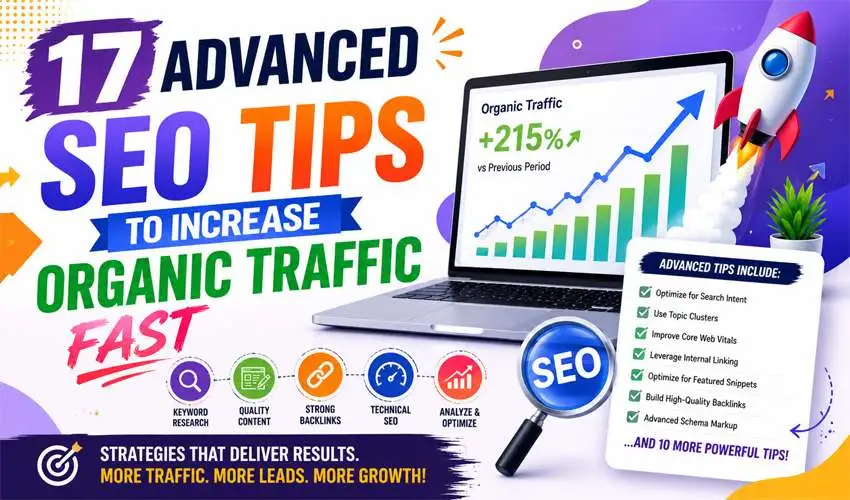
17 Advanced SEO Tips to Increase Organic Traffic Fast
You’ve set up Google Search Console. You’ve written keyword-optimized content. You’ve built a few backlinks. But your traffic has plateaued, and you’re wondering what separates the websites sitting at position one from everyone else fighting for scraps on page two.
The answer lies in advanced SEO — the layer of strategy, analysis, and technical precision that casual optimizers overlook. These aren’t beginner basics rehashed with fancier language. These are the high-leverage moves that seasoned SEO professionals use to compound their results, outmaneuver competitors, and unlock traffic that scales.
Here are 17 advanced SEO tips to increase organic traffic fast — each one actionable, battle-tested, and ready to implement.
1. Fix Crawl Budget Waste Immediately
Search engine crawlers don’t have unlimited time to spend on your site. They allocate a “crawl budget” — and if yours is being wasted on low-value pages like faceted navigation URLs, session IDs, or duplicate parameter pages, your important content gets crawled less frequently.
Audit your site using Google Search Console’s Coverage report and tools like Screaming Frog. Identify pages generating crawl waste and block them via robots.txt or canonical tags. Freeing up crawl budget means your best content gets indexed faster and re-evaluated more often.
2. Target “Striking Distance” Keywords
One of the fastest wins in SEO is improving rankings for keywords where you already sit between positions 5 and 15. These are your striking distance keywords — close enough to page one that a targeted content refresh can move them up dramatically.
Pull your keyword data from Google Search Console, filter for keywords with high impressions but low click-through rates, and update those pages. Add more depth, sharpen the title tag, improve internal linking, and ensure the content matches the search intent more precisely than your competitors.
3. Implement Topic Clusters, Not Just Isolated Articles
Google increasingly rewards sites that demonstrate topical authority — comprehensive expertise across an entire subject area rather than random one-off articles. The topic cluster model helps you build this.
Choose a broad “pillar” topic and create one comprehensive page covering it at a high level. Then build multiple supporting cluster pages around specific subtopics, all internally linked back to the pillar. This architecture signals to Google that your site is an authoritative hub on that subject, lifting rankings across all connected pages.
4. Optimize for Featured Snippets Deliberately
Featured snippets — the answer boxes that appear at the top of Google results — can double or triple your click-through rate from a single ranking. And unlike regular rankings, you don’t need to be in position one to earn one.
To target them, identify questions your audience asks and structure your content to answer them directly. Use short, clean paragraphs of 40–60 words for paragraph snippets, numbered lists for step-by-step snippets, and tables for comparison-based queries. Add an explicit question as a subheading directly above your answer.
5. Leverage Schema Markup for Rich Results
Schema markup is structured data added to your HTML that tells search engines exactly what your content means — not just what it says. When implemented correctly, it can unlock rich results like star ratings, FAQ dropdowns, recipe details, event listings, and product prices directly in search results.
These enhanced listings stand out visually and earn significantly higher click-through rates. Use Google’s Structured Data Markup Helper to generate schema code, then validate it with the Rich Results Test tool before publishing.
6. Conduct a Deep Content Pruning Audit
More content does not equal more traffic. Low-quality, thin, or outdated content can actively drag down your entire domain’s authority in Google’s eyes. Content pruning — the process of removing, consolidating, or improving underperforming pages — often produces dramatic traffic gains.
Audit every page on your site. Pages with low traffic, zero backlinks, thin word counts, and poor engagement metrics are candidates for pruning. Either redirect them to stronger related pages, merge them into a more comprehensive piece, or update them with substantial new value before re-indexing.
7. Build Programmatic Internal Links at Scale
Most websites under-utilize internal linking. Advanced SEOs treat internal links as a deliberate ranking lever — strategically pointing link equity toward the pages they most want to rank.
Go beyond manual linking. Use site search to find every page where a target keyword appears, then add contextual links to the page you want to rank. For large websites, tools like Link Whisper or custom scripts can automate this at scale. Pay particular attention to your highest-authority pages — pointing links from them to newer content gives those pages an immediate credibility boost.
8. Optimize Core Web Vitals Beyond “Passing”
Google’s Core Web Vitals — Largest Contentful Paint (LCP), Interaction to Next Paint (INP), and Cumulative Layout Shift (CLS) — are confirmed ranking factors. Most sites aim just to “pass.” Advanced SEOs push for elite scores, because the gap between passing and excellent can still separate you from the competition.
Use Chrome User Experience Report data and PageSpeed Insights to identify real-world performance issues. Prioritize server response time improvements, eliminate render-blocking scripts, lazy-load offscreen images, and pre-connect to critical third-party origins. Every millisecond genuinely matters.
9. Reverse-Engineer Competitor Backlink Gaps
Stop guessing which links to build. Use tools like Ahrefs or Semrush to run a backlink gap analysis — comparing your link profile against your top three competitors to find high-quality sites that link to them but not to you.
These are your warmest outreach prospects. The site has already demonstrated willingness to link to content like yours. Reach out with a superior resource, a unique angle, or an updated version of whatever earned your competitor their link.
10. Create Data-Driven Original Research
Original research, surveys, and proprietary data are among the most powerful link magnets in SEO. Industry journalists, bloggers, and publications constantly seek original statistics to cite — and when they do, they link back to the source.
Survey your audience, analyze your own platform data, or compile publicly available data into a fresh study. Publish it as a standalone report, pitch it to industry publications, and update it annually. A single strong data study can earn hundreds of backlinks passively over years.
11. Optimize for “People Also Ask” Boxes
The People Also Ask (PAA) section in Google results is expanding aggressively. Appearing in these boxes gives you additional real estate in the SERP and positions your brand as an authority that answers follow-up questions.
Research PAA questions for your target keywords using tools like AlsoAsked or Semrush. Incorporate these questions as subheadings throughout your content and answer them concisely beneath each one. This also naturally improves FAQ schema opportunities.
12. Pursue Strategic Digital PR for Authority Links
The highest-quality backlinks — from major news outlets, universities, and government sites — rarely come from traditional outreach. They come from earned media coverage and digital PR campaigns.
Create genuinely newsworthy content: original studies, bold industry predictions, controversial but well-reasoned opinion pieces, or real-time data tools. Pitch them to journalists covering your industry using platforms like Cision or simply via Twitter/X, where many journalists actively seek sources. One link from a major publication can move rankings faster than fifty links from average blogs.
13. Optimize Click-Through Rate With Title Tag Testing
Ranking on page one means nothing if nobody clicks your result. Title tag optimization is one of the most overlooked advanced techniques because it sits at the intersection of SEO and copywriting.
Test different title formulas: numbers vs. questions, power words vs. straightforward descriptions, current-year inclusion vs. omission. Monitor CTR changes in Google Search Console over 30-day windows. Even a 1% improvement in CTR across your top 50 pages can generate thousands of additional monthly visits.
14. Build Topical Authority With Semantic SEO
Modern Google doesn’t just match keywords — it understands concepts, entities, and relationships between ideas. Semantic SEO is the practice of writing content that covers a topic with the depth and breadth a true subject-matter expert would.
Use tools like Surfer SEO or Clearscope to analyze which related terms, entities, and concepts appear in top-ranking content for your target keyword. Incorporate missing semantic terms naturally into your writing. This signals comprehensiveness to Google’s natural language processing algorithms.
15. Recover Lost Backlinks Immediately
Every website loses backlinks over time — pages get deleted, URLs change, sites redesign. These are broken links pointing to your site that are silently bleeding away your authority.
Use Ahrefs or Semrush to pull a list of lost backlinks from the past six months. For each lost link, identify whether the linking page still exists. If it does, reach out to the webmaster and ask them to update the URL. For your own changed URLs, set up 301 redirects from old pages to new equivalents. Recovering even a handful of high-quality lost links can produce meaningful ranking improvements.
16. Target Zero-Click Searches Strategically
Not all SEO success is measured in clicks. Zero-click searches — where users get their answer directly in the SERP — are growing rapidly. While this might sound like lost traffic, smart SEOs turn it into brand visibility.
By consistently appearing in featured snippets, knowledge panels, and PAA boxes for branded and informational queries, you build trust and familiarity with your target audience. When they’re ready to make a decision, your brand is already the one they recognize. Zero-click visibility leads to direct traffic and branded search growth over time.
17. Build an SEO Flywheel With Content Repurposing
Advanced SEOs don’t just create content — they multiply it. Every long-form article you publish is raw material for a YouTube video, a LinkedIn post, a Twitter/X thread, a podcast episode, and an email newsletter. Each distribution channel drives awareness that eventually converts into branded searches and backlinks.
Branded search — people Googling your website or name directly — is one of the strongest trust signals you can send to Google. A content repurposing flywheel builds brand, drives direct traffic, earns organic backlinks, and compounds your organic rankings in ways that purely on-page tactics never can.
Conclusion
Advanced SEO is not about chasing algorithm updates or discovering secret tricks. It is about executing a coherent, layered strategy where technical precision, content depth, and authority-building reinforce each other continuously.
Pick three to five of these tips that align most closely with your site’s current weaknesses. Execute them thoroughly before moving on. Track results, iterate, and build momentum. The websites winning in organic search aren’t doing a hundred things adequately — they’re doing a core set of things exceptionally well, consistently, over time.
That’s the real advanced SEO secret. And now you have it.